If you have ever searched for the best online marketing tool and ended up more confused than when you started, you are not alone.
I spent months trying random tools when I first started MarketingPrime Some were too complicated. Some were too expensive. And most of them simply did not deliver what they promised. The result? Wasted time, wasted money, and barely any traffic to show for it.
But here is what changed everything for me — I stopped chasing every shiny tool and started focusing on a small, tested stack of tools that genuinely moved the needle. Today, I am going to share exactly those tools with you.
In this article, you will find 7 of the best online marketing tools available in 2026 — each one personally tested, honestly reviewed, and explained with real examples from my own experience.
Why Choosing the Right Online Marketing Tool Matters
The digital marketing space in 2026 is noisier than ever. AI content is flooding the internet, competition for Google rankings has intensified, and user attention spans have dropped. In this environment, working without the right tools is not just inefficient — it is a competitive disadvantage.
The right online marketing tool does three things: it saves you hours every week, it replaces guesswork with real data, and it helps you stay one step ahead of competitors who are still doing everything manually.
Here is the good news — you do not need twenty different tools. The right five to seven, used consistently, will outperform any overcomplicated setup. If you want a broader view of what belongs in your toolkit, check out this complete digital marketing tools list we put together for every stage of growth.
7 Best Online Marketing Tools in 2026
1. Google Analytics 4 — Know Exactly What Is Happening on Your Website
Google Analytics 4, also known as GA4, is the single most important online marketing tool for any website owner. It tells you who is visiting your site, where they are coming from, how long they stay, which pages they love, and exactly where they leave.
Without this data, you are essentially making marketing decisions in the dark.
Here is a real example from MarketingPrime.in: I noticed one of my blog posts had an 85% bounce rate. GA4 pointed me directly to the problem — users were landing on the page and leaving immediately because the content did not match their intent. I rewrote the article, improved the structure, and added better internal links. Within three weeks, the bounce rate dropped to 52% and time on page doubled.
That is not magic. That is data-driven marketing — and GA4 gives you exactly that, completely free.
Cost: Free. No excuses not to set this up today.
2. Google Search Console — Your Direct Connection to Google’s Feedback
While GA4 covers your visitors, Google Search Console covers something different: how Google itself sees and evaluates your website. This tool shows you which keywords your site ranks for, which pages get the most impressions, whether Google can crawl your site properly, and if there are any technical issues affecting your visibility.
I use Search Console every single week without exception. A few months ago, I spotted that one of my posts was sitting at position 8 on Google — decent, but not good enough for meaningful traffic. Search Console data showed me the click-through rate was unusually low. The fix was simple: I rewrote the title tag and meta description to be more compelling and specific. Within two weeks, the same post moved to position 4.
One small change, powered by clear data. That is what this tool enables.
Cost: Free. This is Google’s own product — there is nothing more authoritative for SEO feedback.
3. SEMrush — The Most Complete Online Marketing Tool for Research
If I could only keep one paid online marketing tool, it would be SEMrush — no question. The depth of data it provides is genuinely unmatched. Keyword research, competitor backlink analysis, domain authority tracking, keyword gap analysis, rank tracking — it is all in one place.
When I was writing content around the “digital marketing tools” topic, I ran a quick competitor analysis on SEMrush. I found a specific subtopic that the top five ranking articles were completely ignoring. I built my article around that gap. The post reached the top 5 in Google within three months.
That is the kind of competitive insight SEMrush gives you — and it is very difficult to replicate with free tools alone.
Cost: Free plan includes 10 searches per day, which is a solid starting point. Paid plans begin at $119 per month for professional use.
4. Canva — Professional Visuals Without a Designer or a Big Budget
Every piece of content you publish needs visual support — blog banners, social media graphics, infographics, YouTube thumbnails. Without strong visuals, even excellent content gets ignored.
Canva solves this problem completely. The drag-and-drop interface is simple enough for absolute beginners, but powerful enough to create genuinely professional-looking designs. Every graphic you see across MarketingPrime’s social channels was made in Canva.
Beyond saving money on design work, Canva also saves significant time. What once took me 45 minutes now takes 10. At scale, that difference adds up to hours every week.
Cost: The free plan covers most use cases for bloggers and small businesses. The Pro plan costs approximately Rs. 4,000 per year in India — worth every rupee if you publish content regularly.
5. Mailchimp — Build an Email List That Becomes Your Most Reliable Traffic Source
Here is something most new marketers underestimate: your email list is the only audience you truly own. Social media platforms change their algorithms. Google updates its ranking systems. But your email list stays yours, always.
Mailchimp is the easiest online marketing tool to get started with for email marketing. You can build subscriber forms, send broadcast emails, set up automated welcome sequences, and track open rates and click-through rates — all without writing a single line of code.
My advice: start building your email list on day one, even if your site is brand new. Every day you delay is a subscriber you did not collect.
Cost: Free plan supports up to 500 subscribers with 1,000 emails per month — the perfect starting point for most bloggers.
6. Hootsuite — Manage Every Social Media Account from One Dashboard
Logging into Instagram, then Facebook, then LinkedIn, then Twitter to post manually every day is a time drain that adds up fast. Hootsuite eliminates that friction by letting you schedule content across all platforms from a single dashboard.
I tested both approaches for a full month. Posting manually was taking me nearly three hours per week. After switching to Hootsuite, the same volume of content took 45 minutes. That is more than two hours reclaimed every single week — hours I redirected into writing better content and doing deeper keyword research.
Cost: Free plan covers 2 social accounts and 5 scheduled posts at a time. Paid plans start at $99 per month for growing teams.
7. Jupiter SEO Tools — The All-in-One SEO Platform Worth Knowing About
Most marketers jump between five different tools just to complete one SEO workflow. Jupiter SEO Tools solves that by combining keyword research, competitor analysis, technical site auditing, and backlink tracking into a single dashboard.
What makes it stand out for beginners is the clarity of its interface. The data is presented in a way that is immediately actionable — you do not need to be an SEO expert to understand what to fix or what to target next. For marketers who are tired of tab-switching mid-workflow, it is a genuinely practical solution.
If you want a full breakdown of how to use it and what to expect, I have written a detailed guide on this exact tool for MarketingPrime.in.
Cost: Check the official site for current pricing — plans are available for both individual marketers and agencies.
Which Online Marketing Tool Should You Start With? A Step-by-Step Roadmap
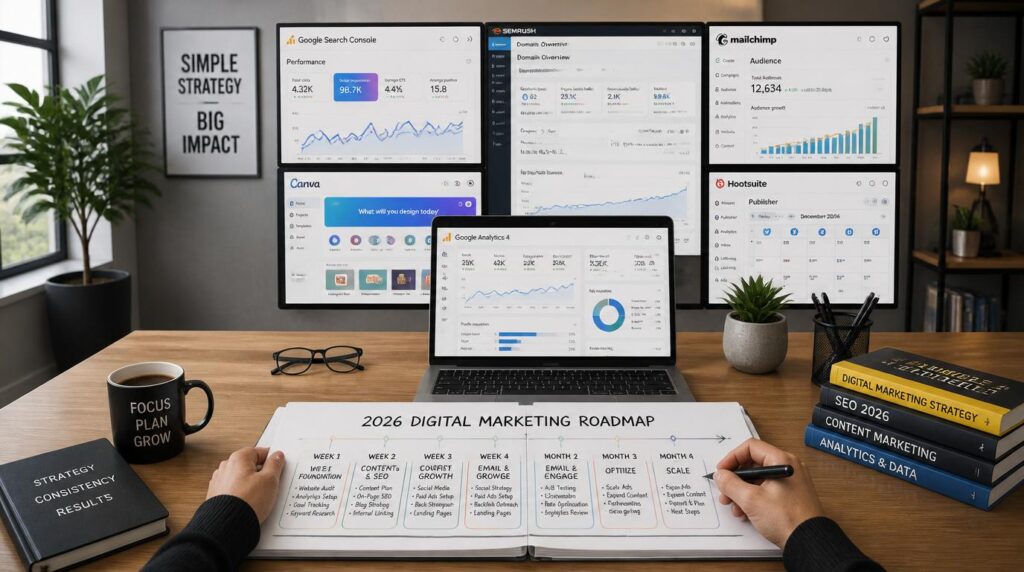
Do not try to implement all seven tools at once. The overwhelm will kill your momentum. Follow this sequence instead:
Weeks 1 and 2: Set up Google Search Console and Google Analytics 4. These two free tools give you the data foundation everything else is built on.
Weeks 3 and 4: Start using Canva to create consistent visuals for your content and social media.
Month 2: Use SEMrush’s free plan to do keyword research before writing any new blog post.
Month 3: Set up Mailchimp and start collecting email subscribers from your website.
Month 4 and beyond: Add Hootsuite once your social media posting has become consistent enough to benefit from scheduling.
This is the exact roadmap I followed when building MarketingPrime.in. Each tool compounds the results of the one before it. Give it six months and the difference will be undeniable.
What I Recommend
The best online marketing tool is not the most expensive one or the most feature-rich one. It is the one you will actually use consistently — one that fits your current stage of growth and gives you data you can act on immediately.
Start with the free tools. Learn them properly. Then invest in paid tools as your results justify the expense. That approach will take you much further than buying every premium tool upfront and using none of them well.
If you want to build a proper strategy around these tools, start with a solid digital marketing plan example — it will give you the framework to make every tool on this list work harder.
If you try any of these tools, drop a comment below and share what results you are seeing. I read every single one and will respond directly.
About the Author: Anant Kumar is a digital marketer and blogger who runs MarketingPrime.in, a blog and agency focused on SEO, content marketing, and organic traffic growth. Every tool in this article has been personally tested through real campaigns